Download BRS Behavioral Science Fifth Edition by Barbara Fadem


Sinopsis

The function and state of the mind are of significant importance to the physical health of an individual. The United States Medical Licensing Examination (USMLE) is closely attuned to the substantial power of the mind–body relationship and extensively tests this area on all three steps of the examination. This review was prepared as a learning tool to help students rapidly recall information that they learned in the first two years of medical school in behavioral science, psychiatry, epidemiology, and related courses. The fifth edition of BRS Behavioral Science contains 26 chapters. All chapters start with a “Typical Board Question,” which serves as an example for the manner in which the subject matter of that chapter is tested on the USMLE. Each chapter has been updated to include the most current information.

A total of 634 USMLE-style questions (about 70 more than in the fourth edition) and answers with detailed explanations are presented after each chapter, as well as at the end of the Comprehensive Examination. Many of these questions were written expressly for this fifth edition and reflect USMLE style, using clinical vignettes in the stem and “quote” format in the answer. Many tables are included in the book to provide quick access to essential information.

Content

  1. THE BEGINNING OF LIFE: PREGNANCY THROUGH PRESCHOOL
  2. SCHOOL AGE, ADOLESCENCE, SPECIAL ISSUES OF DEVELOPMENT, AND ADULTHOOD
  3. AGING, DEATH, AND BEREAVEMENT
  4. GENETICS, ANATOMY, AND BIOCHEMISTRY OF BEHAVIOR
  5. BIOLOGICAL ASSESSMENT OF PATIENTS WITH PSYCHIATRIC SYMPTOMS
  6. PSYCHOANALYTIC THEORY AND DEFENSE MECHANISMS
  7. LEARNING THEORY
  8. CLINICAL ASSESSMENT OF PATIENTS WITH BEHAVIORAL SYMPTOMS
  9. SUBSTANCE ABUSE
  10. NORMAL SLEEP AND SLEEP DISORDERS
  11. SCHIZOPHRENIA AND OTHER PSYCHOTIC DISORDERS
  12. MOOD DISORDERS
  13. ANXIETY, SOMATOFORM AND FACTITIOUS DISORDERS, AND MALINGERING 
  14. COGNITIVE, PERSONALITY, DISSOCIATIVE, AND EATING DISORDERS
  15. PSYCHIATRIC DISORDERS IN CHILDREN
  16. BIOLOGIC THERAPIES: PSYCHOPHARMACOLOGY
  17. PSYCHOLOGICAL THERAPIES
  18. THE FAMILY, CULTURE, AND ILLNESS
  19. SEXUALITY
  20. AGGRESSION AND ABUSE
  21. THE PHYSICIAN-PATIENT RELATIONSHIP
  22. PSYCHOSOMATIC MEDICINE
  23. LEGAL AND ETHICAL ISSUES IN MEDICINE
  24. HEALTH CARE IN THE UNITED STATES
  25. EPIDEMIOLOGY
  26. STATISTICAL ANALYSES


Download PDF Organizational Behavior 15 Stephen 15 Edition P. Robbins


Sinopsis

The details of this story might be disheartening to read, but they accurately reflect some of the problems faced by the contemporary workforce. The story also highlights several issues of interest to organizational behavior researchers, including motivation, emotions, personality, and communication. Through the course of this book, you’ll learn how all these elements can be studied systematically.

You’ve probably made many observations about people’s behavior in your life. In a way, you are already proficient at seeing some of the major themes in organizational behavior. At the same time, you probably have not had the tools to make these observations systematically. This is where organizational behavior comes into play. And, as we’ll learn, it is much more than common sense, intuition, and soothsaying. To see how far common sense gets you, try the following from the Self- Assessment Library.

Content

  1. What Is Organizational Behavior?
  2.  Diversity in Organizations 
  3. Attitudes and Job Satisfaction 
  4. Emotions and Moods
  5. Personality and Values
  6. Perception and Individual Decision Making 
  7. Motivation Concepts 
  8. Motivation: From Concepts to Applications 
  9. Foundations of Group Behavior 
  10. Understanding Work Teams 
  11. Communication 
  12. Leadership 
  13. Power and Politics 
  14. Conflict and Negotiation 
  15. Foundations of Organization Structure
  16. Organizational Culture
  17. Human Resource Policies and Practices 
  18. Organizational Change and Stress Management


Download PDF 50 Great Myths Of Populae Psychology Shattering Widespread Misconception About Human Behavior


Sinopsis

In this book, you’ll encounter 50 myths that are commonplace in the world of popular psychology. These myths span much of the broad landscape of modern psychology: brain functioning, perception, development, memory, intelligence, learning, altered states of consciousness, emotion, interpersonal behavior, personality, mental illness, the courtroom, and psychotherapy. You’ll learn about the psychological and societal origins of each myth, discover how each myth has shaped society’s popular thinking about human behavior, and find out what scientific research has to say about each myth. At the end of each chapter, we’ll provide you with a list of additional psychological myths to explore in each domain. In the book’s postscript, we’ll offer a list of fascinating findings that may appear to be fictional, but that are actually factual, to remind you that genuine psychology is often even more remarkable—and difficult to believe—than psychomythology.

Debunking myths comes with its share of risks (Chew, 2004; Landau & Bavaria, 2003). Psychologist Norbert Schwarz and his colleagues (Schwarz, Sanna, Skurnik, & Yoon, 2007; Skurnik, Yoon, Park, & Schwarz, 2005) showed that correcting a misconception, such as “The side effects of a flu vaccine are often worse than the flu itself,” can sometimes backfire by leading people to be more likely to believe this misconception later. That’s because people often remember the statement itself but not its “negation tag”—that is, the little yellow sticky note in our heads that says “that claim is wrong.” Schwarz’s work reminds us that merely memorizing a list of misconceptions isn’t enough: It’s crucial to understand the reasons underlying each misconception. His work also suggests that it’s essential for us to understand not merely what’s false, but also what’s true. Linking up a misconception with the truth is the best means of debunking that misconception (Schwarz et al., 2007). That’s why we’ll spend a few pages explaining not only why each of these 50 myths is wrong, but also how each of these 50 myths imparts an underlying truth about psychology.

Fortunately, there’s at least some reason to be optimistic. Research shows that psychology students’ acceptance of psychological miscon ceptions, like “people use only 10% of their brain’s capacity,” declines with the total number of psychology classes they’ve taken (Standing & Huber, 2003). This same study also showed that acceptance of these misconceptions is lower among psychology majors than non-majors. Although such research is only correlational—we’ve already learned that correlation doesn’t always mean causation—it gives us at least a glimmer of hope that education can reduce people’s beliefs in psychomythology. What’s more, recent controlled research suggests that explicitly refuting psychological misconceptions in introductory psychology lectures or readings can lead to large—up to 53.7%—decreases in the levels of these misconceptions (Kowalski & Taylor, in press).

If we’ve succeeded in our mission, you should emerge from this book not only with a higher “Psychology IQ,” but also a better understand ing of how to distinguish fact from fiction in popular psychology. Per haps most important, you should emerge with the critical thinking tools needed to better evaluate psychological claims in everyday life.

As the paleontologist and science writer Stephen Jay Gould (1996) pointed out, “the most erroneous stories are those we think we know best—and therefore never scrutinize or question” (p. 57). In this book, we’ll encourage you to never accept psychological stories on faith alone, and to always scrutinize and question the psychological stories you think you know best.

So without further ado, let’s enter the surprising and often fascinating world of psychomythology.


Download PDF Handbook of Behavioral and Emotional Problems in Girls By Debora J. Bell


Sinopsis

Historically, girls have evoked images of sweetness and light, purity and beauty. In this fairytale land of youth, girls are angels and princesses, characterized by positive adjustment and certainly not by behavioral or emotional problems. However, as Mae West observed, in reality female children and adolescents are much more complex, with both positive and negative aspects to their development and adjustment. Unfortunately, the complexity has been understudied in the developmental psychopathology literature. Compared to the amount of research attention given to boys’ development and adjustment, girls have been relatively neglected. This lack of attention has obvious negative implications for our ability to understand girls’ development and our efforts to promote optimal development and to remediate problematic development.

Content


  1. Introduction
  2. Emotional Disorders
  3. Behavioral Disorders
  4. Developmental and Learning Disorders
  5. Stress and Negative Life Events
  6. Health-Related Problems


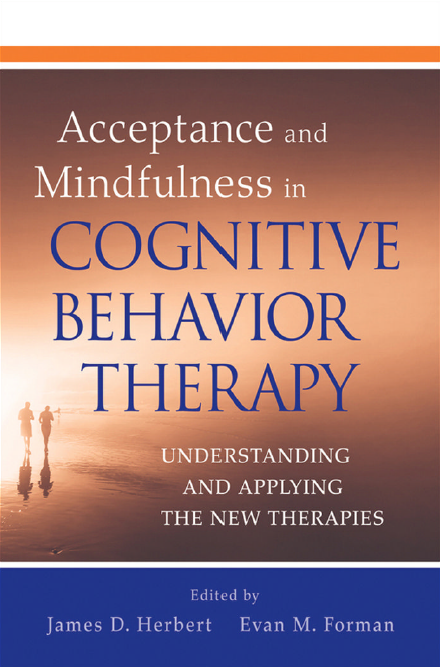
Download PDF Acceptance and Mindfulness in Cognitive Behavior Therapy : Understanding and Applying the New Therapies by James D. Herbert And Evan M. Forman


Sinopsis

Cognitive behavior therapy (CBT) has now become the dominant force in psychotherapy in much of the world, including North America, the United Kingdom, much of Europe, and increasingly throughout Asia and Latin America. The rise of CBT is due to the confluence of several factors, primary among which is the increased focus on evidence-based practice and associated calls for accountability in the delivery of behavioral health services (Baker, McFall, & Shoham, 2009). Throughout its history, CBT has been committed to a scientifi c perspective to the study of psychopathology and its treatment. Hundreds of studies have evaluated various cognitive behavioral theories of psychopathology, and hundreds more have assessed the efficacy of CBT interventions. Th is scientific literature has placed CBT in a unique position to dominate the field of psychotherapy.

Content

  1. Th e Evolution of Cognitive Behavior Therapy: The Rise of Psychological Acceptance and Mindfulness
  2. Cognitive Therapy
  3. Mindfulness-Based Cognitive Therapy
  4. Metacognitive Therapy
  5. Emotional Schema Therapy: A Bridge Over Troubled Waters
  6. Mindfulness-Based Stress Reduction
  7. Dialectical Behavior Therapy
  8. Behavioral Activation in the Context of “Third Wave” Therapies
  9. Integrative Behavioral Couple Therapy: An Acceptance-Based Approach to Improving Relationship Functioning
  10. Understanding Acceptance and Commitment Therapy in Context: A History of Similarities and Differences With Other Cognitive Behavior Therapies
  11. Mindfulness and Acceptance: Th e Perspective of Cognitive Therapy
  12. Mindfulness and Acceptance: Th e Perspective of Acceptance and Commitment Therapy
  13. Mindfulness and Acceptance in Cognitive Behavior Therapy: What’s New?