Download PDF THERMODYNAMICS AND HEAT POWERED CYCLES: A COGNITIVE ENGINEERING APPROACH by Chih Wu


Sinopsis

The field of science dealing with the relationships of heat, work, and properties of systems is called thermodynamics. A macroscopic approach to the study of thermodynamics is called classical thermodynamics. In engineering fields, a substance is considered to be in continuum, that is, it is continuously distributed throughout. The facts that matter is made up of molecules and that the molecules have motions are completely ignored. When a system is subjected to transfer of energy or other thermodynamic processes, attention is focused on the behavior of the system as a whole. This approach is mathematically rather simple, and allows engineers to easily describe a system using only a few properties. Engineering thermodynamics is based on this macroscopic point of view. If the continuum assumption is not valid, a statistical method based on microscopic molecular activity may be used to describe a system. The microscopic approach inquires into the motion of molecules, assumes certain mathematical models for the molecular behavior, and draws conclusions regarding the behavior of a system. Such a microscopic approach to the study of thermodynamics is called statistical thermodynamics. The microscopic approach is mathematically complex. Fortunately, the microscopic aspects are not essential in most of the important technical applications. We can obtain excellent engineering solutions using the simpler macroscopic ideas. Therefore, we shall use the macroscopic approach in this text.

Thermodynamics is studied by physicists, chemists, and engineers. Physicists and chemists are concerned with basic laws, properties of substances, and changes in the properties caused by the interaction of different forms of energy. Engineers are interested not only in all these aspects, but also in the application of thermodynamic principles to the design of machines that will convert energy from one form into another. Mechanical engineers are frequently concerned with the design of a system that will most efficiently convert thermalenergy into mechanical energy, or vice versa.

Content

  1. Basic Concepts
  2. Properties of Thermodynamic Substances
  3. First Law of Thermodynamics for Closed Systems
  4. First Law of Thermodynamics for Open Systems
  5. Second Law of Thermodynamics
  6. Entropy
  7. Exergy and Irreversibility
  8. Vapor Cycles
  9. Gas Closed System Cycles
  10. Gas Open System Cycles
  11. Combined Cycle and Co-Generation
  12. Refrigeration and Heat Pump Cycles
  13. Finite-Time Thermodynamics


Download PDF Emotion-Focused Cognitive Therapy by Mick Power


Sinopsis

Psychology lost its soul at the beginning of the twentieth century with the joint onslaught of both American and Russian Behaviourism. As John Watson famously said, ‘the soul is not the remit of science’. However, in the 1950s psychology at least regained its capacity to think – cognitive psychology was reputedly born at a symposium at the Massachusetts Institute of Technology on 11 September 1956 (see Bruner, 1983) and the subsequent development of cognitive science has swamped psychology and the many adjoining areas of linguistics, anthropology, philosophy and artificial intelligence. We should of course be grateful that we are no longer trapped in the onedimensional world of behaviourism, in which we are no better than headless chickens (or pigeons, or rats) running around the farmyard, cage or Skinner Box. Cognitive science has at least given us more computational power – unfortunately, the behaviourist’s computer would still have us using the abacus, or a mechanical equivalent.

And in the field of therapy, cognitive science has given us the many and varied cognitive and cognitive behavioural therapies. Yes, of course we should be grateful to be given back our thinking minds. At least the cognitive and cognitive behavioural therapies acknowledge that we have thoughts and beliefs and assumptions and schemas. It often makes sense to our clients that theymay overvalue one thought at the expense of another, or they may have a mistaken belief about their own worthlessness as people, or they may believe that they are about to die of a heart attack when they are not.We knowas clinicians that many of our clients can be helped by examining their cognitions and by examining the possibility that alternative cognitions would be more functional and would help them improve their well-being and general life satisfaction.

Cognitive science and cognitive behavioural therapies can absolutely be congratulated for the benefits they have brought to academics, to clinicians and to clients. But unfortunately something has been left out in these great strides forward – and that is emotion. There has been growing recognition in the past 20 years or so that cognition is not enough.We may now be able to produce computers that can play a good game of chess, but we are yet to see a computer commit suicide because it was rejected in love, or take out a gun and shoot someone because of an insult to its mother (or perhaps its motherboard?). Much of what we do as humans is motivated by emotion. We build a monument to the person we have loved and lost because we are overwhelmed with grief and want to find a way to express those emotions. We strive for wealth, fame and success because we believe those things will make us happy – whether or not they will – if or when we ever achieve them. We move to another country and learn to speak Russian because we fall in love.We avoid leaving the house at a certain time because we hate our neighbours, who leave rubbish in our drive-way because they hate us! We teach our children to look right and left as they cross the road because we are terrified of what might happen to them if they carelessly forget. The list of emotion-motivated things we do is endless. Emotion is constantly with us and guiding us, for that is its purpose.When emotions function well and properly, they help us to prioritize, to work when we would rather play, to choose between otherwise impossible choices, and to avoid situations and objects that might be dangerous or unhealthy or disease ridden. The well-functioning emotion system is there to guide and protect – emotions are the 10 commandments of the psychological world. But as any powerful system, the emotion system can run out of control. Danger can be signalled when there is no objective danger – the harmless spider in the bath really does not warrant that level of panic and disgust. Or, the person can be so overwhelmed by feelings of despair and self-disgust that he or she would rather be dead. Or, the driver cutting in front of us can instantly fill us with an inexplicable feeling of road rage that causes us to put lives in danger.

Content

  1. Introduction
  2. WhatisanEmotion?
  3. Therapy 
  4. The Assessment of Emotion 
  5. Too Much Emotion 
  6. Too Little Emotion 
  7. Additional Topics 
  8. An Overview of EFCT


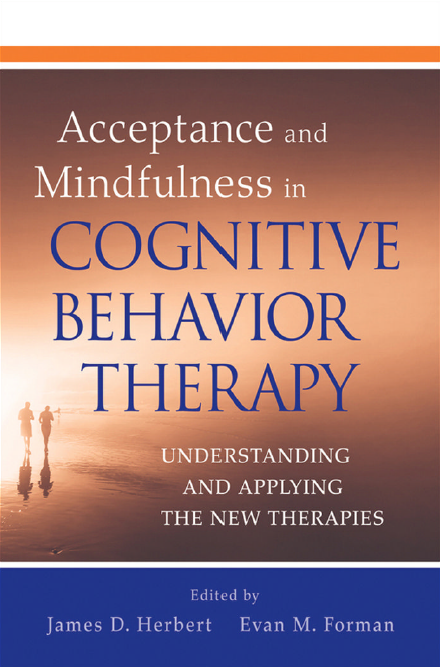
Download PDF Acceptance and Mindfulness in Cognitive Behavior Therapy : Understanding and Applying the New Therapies by James D. Herbert And Evan M. Forman


Sinopsis

Cognitive behavior therapy (CBT) has now become the dominant force in psychotherapy in much of the world, including North America, the United Kingdom, much of Europe, and increasingly throughout Asia and Latin America. The rise of CBT is due to the confluence of several factors, primary among which is the increased focus on evidence-based practice and associated calls for accountability in the delivery of behavioral health services (Baker, McFall, & Shoham, 2009). Throughout its history, CBT has been committed to a scientifi c perspective to the study of psychopathology and its treatment. Hundreds of studies have evaluated various cognitive behavioral theories of psychopathology, and hundreds more have assessed the efficacy of CBT interventions. Th is scientific literature has placed CBT in a unique position to dominate the field of psychotherapy.

Content

  1. Th e Evolution of Cognitive Behavior Therapy: The Rise of Psychological Acceptance and Mindfulness
  2. Cognitive Therapy
  3. Mindfulness-Based Cognitive Therapy
  4. Metacognitive Therapy
  5. Emotional Schema Therapy: A Bridge Over Troubled Waters
  6. Mindfulness-Based Stress Reduction
  7. Dialectical Behavior Therapy
  8. Behavioral Activation in the Context of “Third Wave” Therapies
  9. Integrative Behavioral Couple Therapy: An Acceptance-Based Approach to Improving Relationship Functioning
  10. Understanding Acceptance and Commitment Therapy in Context: A History of Similarities and Differences With Other Cognitive Behavior Therapies
  11. Mindfulness and Acceptance: Th e Perspective of Cognitive Therapy
  12. Mindfulness and Acceptance: Th e Perspective of Acceptance and Commitment Therapy
  13. Mindfulness and Acceptance in Cognitive Behavior Therapy: What’s New?